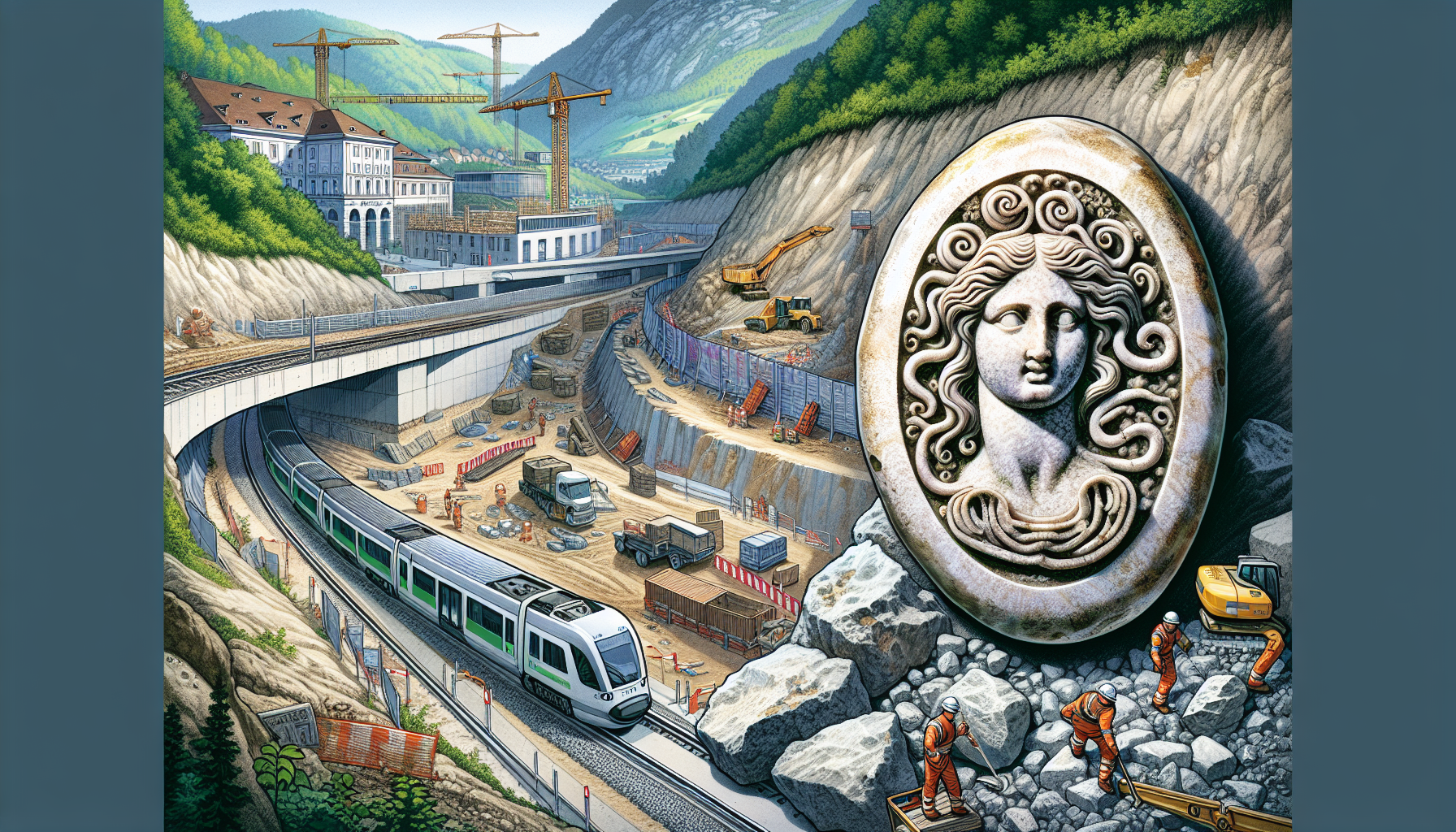
During preparations for a new funicular railway in Hallstatt, Austria, construction workers uncovered an extraordinary Roman cameo featuring the goddess Medusa. The discovery was made earlier this year during excavations by ARDIS Archäologie GmbH and the Upper Austrian State Culture Company, commissioned by Salzwelten GmbH. This upcoming railway system is scheduled to open in June 2026.
Torsten Pedit, managing director of Salzwelten GmbH, highlighted the significance of the find, stating, “This remarkable discovery underscores the deep historical connection of our project with Hallstatt’s past. Without the railway’s construction, this unique artifact might have remained hidden.”
The Medusa cameo, only 1.5 cm in size, is intricately carved from banded agate and considered one of the most important finds from antiquity in Upper Austria. Experts date it to the 2nd century C.E., with origins in a northern Adriatic workshop. It was likely sold as jewelry in Hallstatt, a village with a history dating back 7,500 years and known for its Roman salt mining operations.
Compared to similar cameos found in Wels and Enns, the Hallstatt Medusa is noted for its elaborate carving, depicting the goddess in partial profile. Researchers believe it was worn as a necklace by an elite Roman woman. The cameo was recently displayed at the Cultural and Congress House in Hallstatt and will be part of the permanent collection at Austria’s Linz Castle Museum next year.
Provincial governor Thomas Stelzer remarked on the artifact’s cultural significance, saying it is “a testament to the cultural richness of our region,” and contributes to a deeper understanding and appreciation of our heritage.
Hallstatt has been a focal point for Roman archaeological discoveries since the 19th century when Johann Georg Ramsauer unearthed ancient burial grounds. Significant excavations continued during the mid-20th century, led by Hallstatt-born Friedrich Morton, revealing Roman structures and artifacts from as early as 600 B.C.E. These findings provide valuable insights into life in the Roman province of Noricum.
Hallstatt’s mayor, Alexander Scheutz, expressed his delight over the discovery, celebrating the town’s ongoing legacy of historical revelations.