

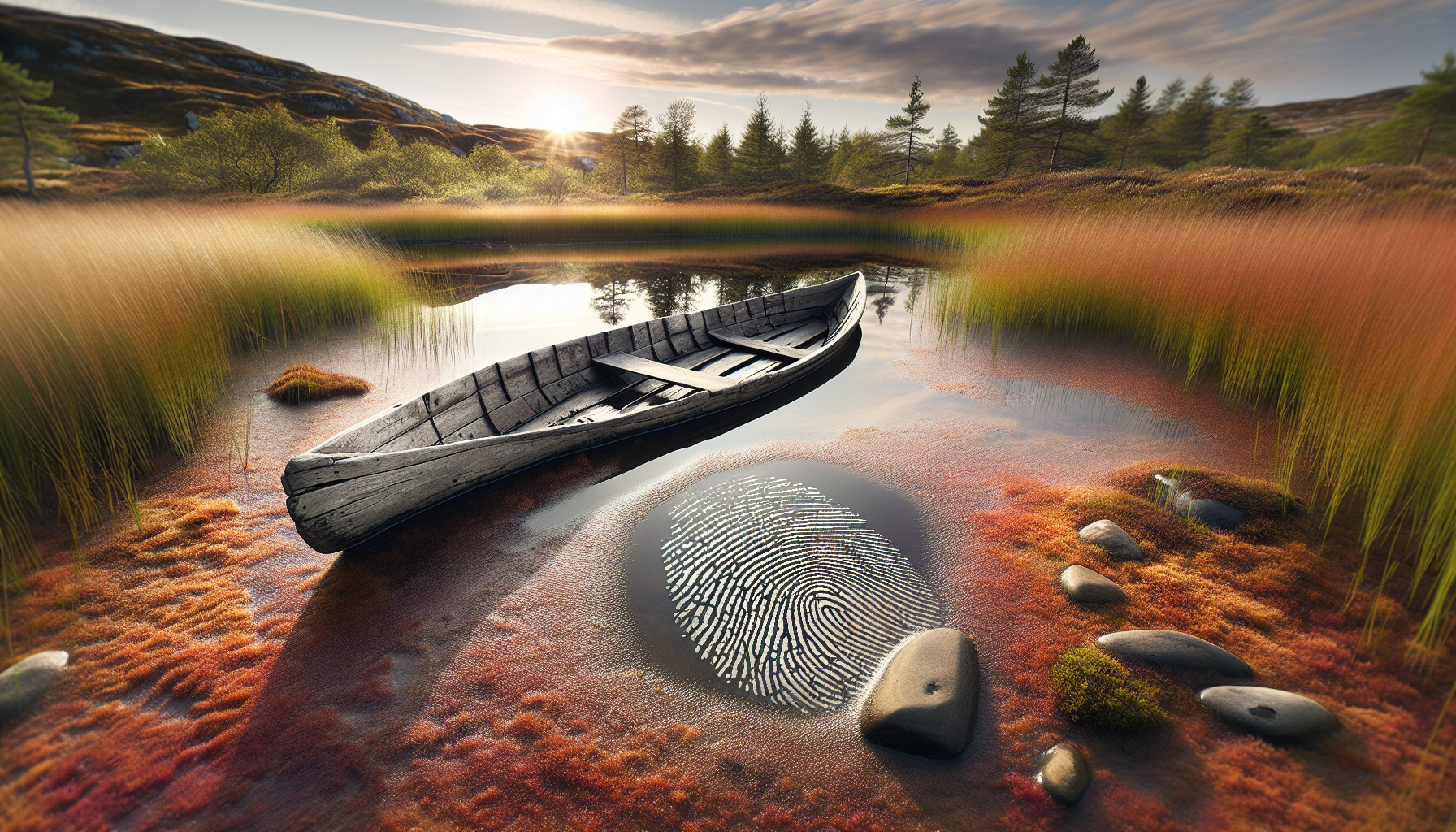
Ancient Fingerprint Discovery Reveals Insights into Scandinavian Seafarers
Researchers have uncovered a 2,400-year-old fingerprint on Scandinavia’s oldest plank boat, believed to belong to someone who worked on its repair. This significant discovery sheds light on the ancient sea raiders’ origins and objectives. The vessel, known as the Hjortspring boat, was found in the Hjortspring Mose bog in southern Denmark during the 1880s and excavated in the 1920s. It is currently displayed at the National Museum of Denmark. Experts suggest the boat was part of a fleet used in an attack on the island of Als, near modern-day Denmark, in the 4th century B.C.E.
The archaeological team from Lund University in Sweden, in partnership with the University of Gothenburg’s Maritime Encounters research program, focused their study on pristine sections of the boat, notably examining fragments of caulking tar and rope. It was within this tar that the ancient fingerprint was discovered, although the identity and gender of the individual remain unknown. Various scientific techniques, including 3D modeling, carbon dating, X-ray tomography, gas chromatography, and mass spectrometry, were employed in the research. Modern ropemakers contributed to the study by demonstrating historical rope-making techniques.
“Our experimental reconstruction of the cordage indicates that strings were combined to create both two- and four-ply cordage during the vessel’s construction,” the researchers noted in their study published in the journal PLOS One. They discovered the caulking’s chemical composition, which combined animal fat with pine pitch, suggesting a Baltic Sea origin rather than the previously assumed area near modern-day Hamburg, Germany. This revelation underscores the seafarers’ impressive maritime capabilities.
“If the boat originated from the pine-rich coastal regions of the Baltic Sea, it implies that the warriors undertook a maritime raid across hundreds of kilometers of open sea,” stated Mikael Fauvelle, the lead archaeologist of the study. Future research might involve examining the tree rings of the boat’s planks and extracting ancient DNA from the caulking tar, which could provide further insights into the people who utilized this vessel.

